At a glance
For candle care, follow the label, use a stable heat-resistant surface and extinguish before leaving or becoming sleepy. Stop use if the vessel is damaged or the flame behaves unusually.
Before you light
Read the label supplied with your candle. Put the vessel on a stable, heat-resistant surface, away from curtains, drafts, children and pets. Follow the product’s specific wick-trimming instructions.
While it burns
Stay with the candle. Follow the labeled burn duration and never move a hot vessel. If you are about to meditate with your eyes closed, lie down or leave the room, extinguish the flame first.
When you finish
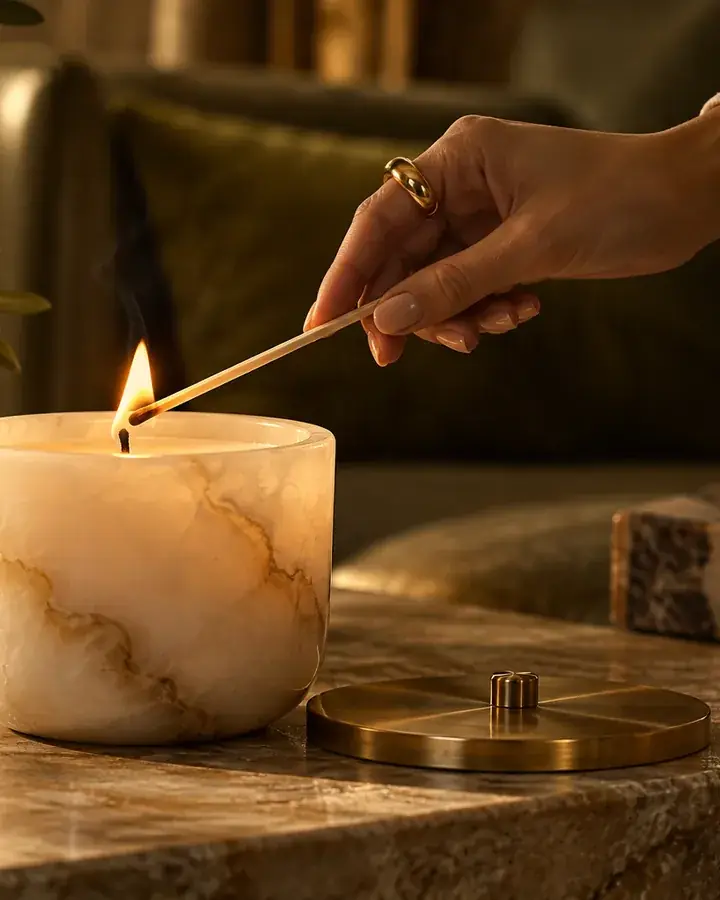
Extinguish according to the product instructions and allow the vessel to cool fully. The next ritual begins with a safe, clean space.
Explore your next stepA practical candle check
- Before lighting, check the cooled vessel for cracks, keep the wax clear of debris and prepare a stable, heat-resistant surface.
- For common wick care, the National Candle Association gives a general trim of about 6 mm (¼ inch). Use the supplied care directions for your wick design; wooden wicks can differ.
- Choose a period when you can stay present. NCA gives a general upper session limit of four hours and cooling time of at least two hours, but a shorter product limit takes precedence. Do not extend a burn just to reach the glass.
- Extinguish before leaving, closing your eyes or becoming sleepy. Let the vessel cool completely before moving it.
Reference: NCA: burning a candle correctly. These are general guidelines, not a verified burn-time specification for every Mahonie product.
| What you notice | What to do next |
|---|---|
| A thin ring of wax remains at the edge | Photograph the cooled candle and compare the maker’s normal melt pattern; never force a longer burn. |
| Visible smoke, a large flame or repeated soot | Extinguish and cool. Check care and placement; stop use if it recurs. |
| A cracked or chipped vessel | Do not relight. Contact the seller rather than trying to repair the container. |
| The wick is buried or looks off-centre | Do not dig into hot wax or reposition a lit wick. Ask for product-specific support. |
Plan the whole burn, including the ending
Before lighting, decide whether you can remain nearby for the whole session. Read the vessel label for wick preparation, burn limits and the point at which use must stop. Put the candle on a stable, heat-resistant surface with clear space around and above it. Keep matches, wick trimmings and decorative material out of the wax. A level surface matters because a tilted vessel changes how melted wax collects and how heat reaches the container.
Recognise a setup problem early
Watch the flame and vessel during use rather than checking only when the candle is almost finished. If the flame behaves unusually, the vessel is damaged or anything nearby becomes unsafe, extinguish the candle and let it cool. Avoid moving a burning candle to correct its location. If soot appears repeatedly, review the wick, draughts and the label directions before the next use. A product that continues to behave unexpectedly deserves a conversation with the seller, not an improvised repair.
Keep a simple care record
If you have several candles, note the fragrance, vessel and any care directions that differ. Multi-wick designs and different wax blends may need different handling; one rule copied from social media is not a substitute for the product label. Photograph a concern only after the candle is extinguished and safe to approach. A clear description of what happened, the approximate burn length and the condition of the wick helps the seller give a more useful response.
Diagnose the problem before changing the product
An uneven melt, a large flame and a weak fragrance are different observations and need different questions. For an uneven melt, consider the label directions and the pattern across several supervised burns. For a large or smoky flame, review wick preparation, draughts and the condition of the vessel once everything is cool. For a weak fragrance, consider the room, your distance and competing odours. Do not attempt to solve any of these by pouring in oil, moving a burning candle or surrounding the flame with foil. Contact the maker if behaviour remains unusual.
Why burn times belong to a particular design
A burn-time claim describes a tested product under stated conditions; it is not simply a calculation from wax weight. Vessel shape, wick arrangement, wax blend and fragrance all matter. Compare candles using the directions and specification for each one. Keep the maximum session length separate from the estimated total life of the candle. When the label or the vessel condition says to stop using it, remaining wax is not a reason to continue. A shorter safe final session is better than trying to extract a promised number of hours.
A useful message to customer care
If you need help, include the exact product name, a clear photo taken when the candle is cool, how the wick was prepared and roughly how long the last session lasted. Describe the observation plainly: one wick went out, the flame became unusually high or soot appeared on the glass. Keep the candle unused while asking about damage or unusual behaviour. This information is more useful than asking whether all soy candles behave the same way, and helps avoid applying advice intended for another vessel or wick system.
Frequently asked questions
Why is my candle tunnelling?
An uneven melt pattern can leave wax at the edges. Check the product’s burn directions and placement before the next use. Do not keep burning beyond the maximum duration to reach the edge. Avoid foil tents, ovens or hot-water hacks that can overheat the container or create a fire risk.
Why is my candle producing soot?
A wick that needs care or a draft can affect the flame. Extinguish the candle safely, let it cool and check the label before trimming or relighting. Keep debris out of the wax. Persistent soot, a large flame or a damaged vessel is a reason to stop and contact the seller.
When should I stop using a candle?
Stop at the remaining-wax limit stated on its label, before heat concentrates at the base. Also stop for cracked glass, unstable wicks or unusual flames. Do not refill an old candle vessel or combine leftover wax unless it is a product specifically designed and approved for that use.
What causes candle wick mushrooming?
A carbon-rich cap can form on the wick and affect how the flame behaves. Extinguish, allow complete cooling and follow the maker’s trimming directions before another use. Remove loose debris from the wax. Do not trim a burning wick or reach into hot wax. If a large flame or persistent smoke returns after correct care, stop using the candle and contact the seller with a photo of the cooled wick and vessel.
How do I clean an empty candle jar?
First confirm the jar is fully cooled and has reached its stated end-of-use point. Ask the maker whether that vessel is intended for reuse and how it should be cleaned. Avoid heating it in an oven, pouring boiling water into glass or using sharp tools against the vessel. Small residual wax can be removed only with a method suitable for the material. Do not pour wax into a drain, and do not assume a cleaned jar is food-safe.
What is the 3-hour rule for candles?
It is a shorthand sometimes used for a candle session, not a universal safety rule. The right duration depends on the particular candle and its care label. Do not force three hours for a product with a shorter limit, or keep burning to correct uneven wax. For general context, the National Candle Association advises avoiding sessions longer than four hours, with cooling between uses; the maker’s instructions for your vessel and wick remain the first reference.
How long should I burn a candle the first time?
Use the duration on that candle’s care label. Let it develop the melt pool described by the maker, while staying within the maximum session time. A universal number cannot account for every vessel and wick design. If the wax remains uneven at the limit, extinguish and ask for product-specific advice rather than extending the burn.
How do I trim a candle wick?
Let the candle cool fully. Use an appropriate wick trimmer to shorten it to the length stated on the label, then remove loose trimmings from the wax. Do not cut so low that the wick cannot be safely relit. Cotton and wooden wicks can need different care, so check your particular candle.
How do I extinguish a candle safely?
Use the method recommended by the maker, keeping your face and loose clothing away. A suitable snuffer is one option. Never pour water into hot wax. Check the flame is completely out and allow the vessel to cool before moving it or putting on a lid that is intended only for storage.
Can I repair candle tunnelling with foil or extra oil?
Avoid improvised changes around a flame or additions to the wax. They can alter heat and combustion in ways the vessel was not designed for. Check the product’s directions and contact the maker with a cool-vessel photo and a description of the burn pattern. Do not continue using a damaged or unusually behaving candle simply to recover the remaining wax.
About this guide
Mahonie Journal · Reviewed 24 October 2026. Practical editorial guidance. Follow the directions supplied with your product; choose practices that suit you. Product pairings are optional.
Further reading: National Candle Association: candle safety.
Further reading: National Candle Association: candle safety.