At a glance
Choose a meditation position that is supported and easy to leave. A chair is a valid starting point; sitting on the floor is not a requirement.
Support and the freedom to move matter more than an ideal meditation pose.
Start with support
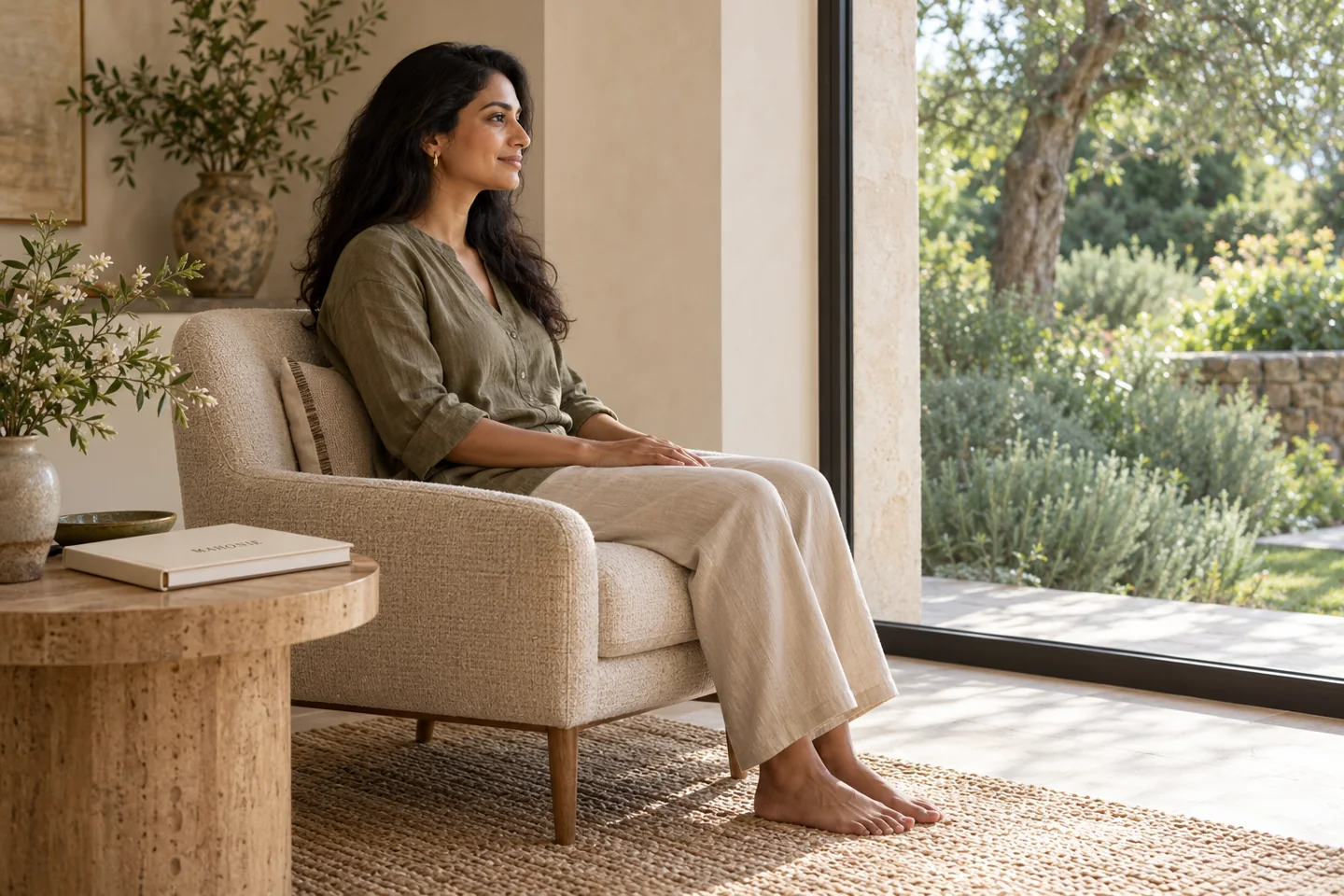
Use a chair, cushion or resting surface that supports you comfortably. Rest the hands where they do not need to hold the body upright. You can keep both feet supported if that works for your position.
Adjust early and often
Change position when something feels uncomfortable. Movement does not invalidate a practice. If scanning a particular body area feels unpleasant, skip it and notice the room or a neutral contact point instead.
For a resting lesson
Extinguish flames before lying down or closing your eyes. Put the screen where you do not need to hold it. Choose a voice volume you can hear without strain, and leave background sound off if it competes with the guidance.
Try a short comparison
Notice your hand touching a surface, then your feet on their support. Which is easier to feel without effort? Choose that point as your anchor for a few moments.
General wellbeing guidance from Mahonie. Adapt or stop any practice when you prefer.
Set up a chair in one minute
Choose a stable chair that lets you change position easily. Sit far enough back to use its support if that is comfortable. Let your feet rest on the floor or a stable support rather than holding them in place through effort. Rest your hands on your thighs, a cushion or the chair arms. Notice whether your shoulders can settle without pushing them down. You can keep a natural curve in your back; there is no need to lift your chest or hold a rigid, unusually straight posture.
Choose floor sitting only when it suits you
If you prefer a cushion, test the position briefly before starting a longer recording. Add support where it makes sitting easier and avoid forcing the knees towards the ground. A folded blanket may make a hard surface more comfortable, but it does not make an unsuitable position suitable. Keep the route to standing clear. If getting down to or up from the floor is difficult, a chair offers a practical alternative. The lesson concerns attention, not achieving a particular seated silhouette.
Make movement part of the practice
Before the recording begins, decide that you are free to move. If a hand becomes uncomfortable, open it; if a foot tingles, change its position. Pause the audio when an adjustment needs your attention. After moving, find one easy point of contact and continue from the next instruction. You do not need to compensate by sitting still for longer afterwards. A repeatable setup is one that lets you finish feeling able to continue your day, rather than proud of having tolerated discomfort.
Finish with an ordinary transition
When the session ends, notice the room before standing. Move at a comfortable pace and take any support you ordinarily use. Note which adjustment was most helpful so the next session needs less preparation. If lying down encourages sleep and your intention is to stay attentive, try a supported chair with a relaxed gaze. For a rest practice, sleepiness may be compatible with your intention. In either case, switch off open flames before beginning and put the device somewhere stable.
Match the position to the task
For a short attention lesson, a stable chair with a relaxed gaze may be easier to use than a bed if you tend to fall asleep. For an intended rest practice, a supported lying position may suit you better. For a shared office, an ordinary seated posture can keep the pause discreet. Choose a position you can enter and leave comfortably in that particular setting. A posture that looks elegant in a photograph may be inconvenient on a hard floor or after a long workday. The question is whether you can listen and adjust without unnecessary effort.
Make one adjustment at a time
If you feel you are working to hold yourself upright, try the back support before changing everything else. If your hands keep moving because they are unsupported, place them on your lap or a cushion. If your eyes feel strained, change your gaze rather than trying harder to concentrate. After each adjustment, listen to the next instruction and notice whether the setup became easier. Keep a note of the useful change. A small practical adjustment is often more informative than adding another fifteen minutes to an uncomfortable session.
Frequently asked questions
How should I sit in a chair?
Place your feet where they feel supported and let the chair carry your weight. Choose a comfortable hand position and a neutral gaze. You can use a cushion or back support. The aim is a workable position, not holding an unusually straight posture throughout the session.
Can I meditate lying down?
Yes, if that is comfortable and safe. You may become sleepy, which can be acceptable for a rest practice but inconvenient for an attention exercise. If you want to stay alert, try sitting or keeping your eyes open. Extinguish any candle before lying down.
Should I stay still when something hurts?
No. Adjust or stop. You can move deliberately, resettle and continue if comfortable. Pain is not a measure of commitment, and a recording cannot know your physical limitations. Choose appropriate support for persistent symptoms rather than trying to meditate through them.
Is there one correct meditation posture for everyone?
No. Choose stable support, a comfortable gaze and room to move according to your body and setting. A chair, cushion or resting position can each be workable for different intentions. Change position rather than treating pain as commitment. If you need individual advice about a physical limitation, a generic recording cannot replace someone qualified to assess that need.
About this guide
Mahonie Journal · Reviewed 24 October 2026. Practical editorial guidance. Follow the directions supplied with your product; choose practices that suit you. Product pairings are optional.
Further reading: NHS: mindfulness.